

Why Relational Thinking Is Becoming Visible Now
Observational Cuts · 07 · Relational Thinking Becomes Legible

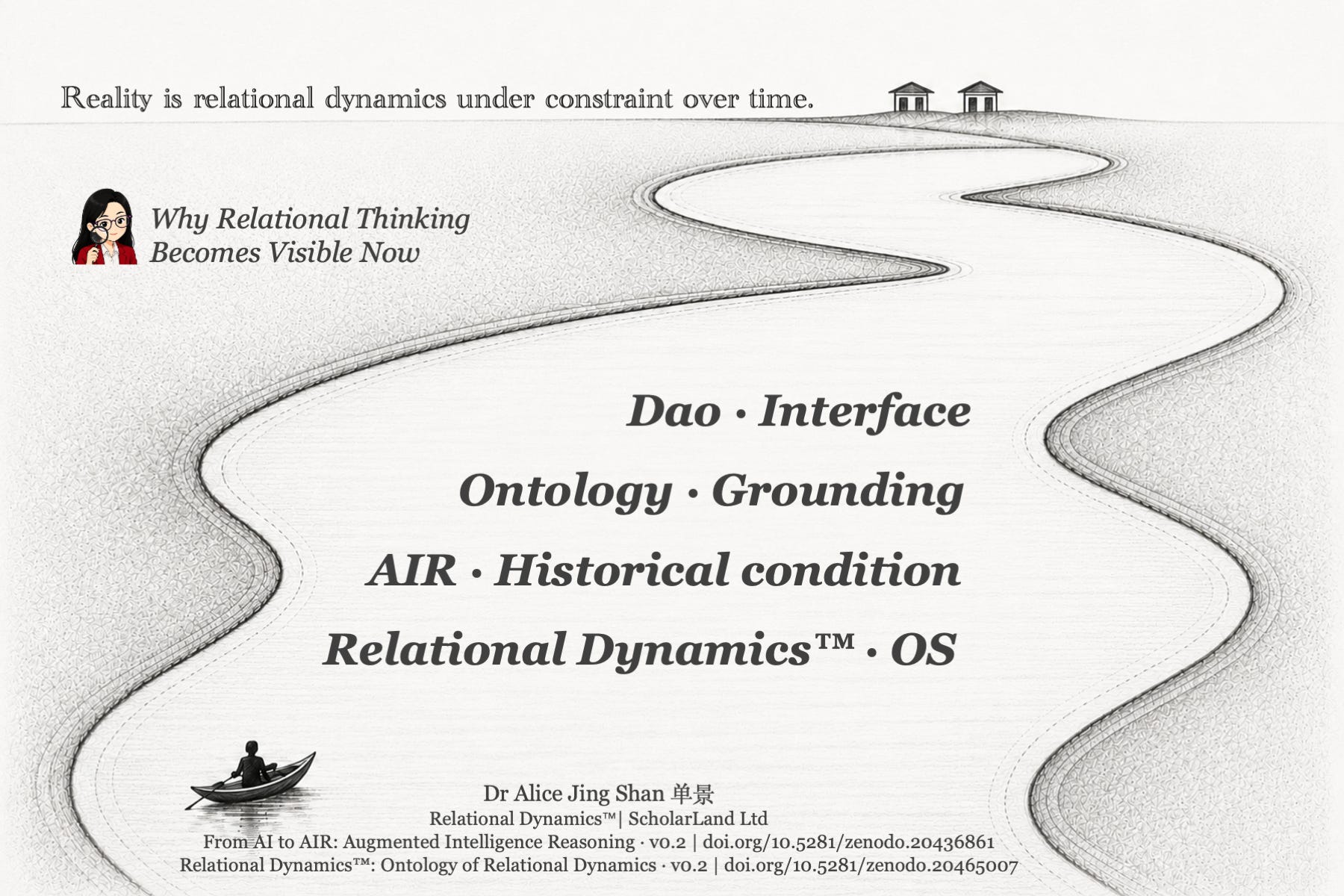
Figure 1. Visual coordinate map for this positioning note. Dao is treated as one interface, the Ontology of Relational Dynamics as grounding, AIR as historical condition, and Relational Dynamics™ as the wider OS.
Update, 24 June 2026: This piece has now been deposited on Zenodo as a positioning note within the Relational Dynamics™ body of work.
DOI: https://doi.org/10.5281/zenodo.20804629
I keep noticing something.
More and more people are reaching for words like relation, process, dynamics, emergence, and ontology. They may come from different traditions and use these words with different levels of precision. The meanings are not always the same.
But the movement is there.
Something that used to feel abstract is becoming practical. Something that used to sound philosophical is becoming operational. Something that used to sit at the edge of theory is moving toward the centre of how we understand AI, education, organisations, governance, and human development.
I do not think this is accidental.
The Old Unit of Analysis Is Breaking Down
Artificial intelligence (AI) is making relational thinking newly visible because the old unit of analysis is breaking down.
For a long time, modern systems trained us to look at separable units: the individual, the tool, the organisation, the model, the learner, the user, the policy, the system. Each could be named, measured, improved, optimised, and sometimes blamed.
That way of thinking was useful. It still is, up to a point.
But it misses what often matters most. The relation.
By relation, I do not mean social warmth or interpersonal kindness, although those may matter too. I mean relation as the condition through which anything becomes meaningful, consequential, and able to move across time.
A human using a tool is one thing. A human thinking inside an AI-shaped environment is another.
A learner asking a question is one thing. A learner forming judgment through repeated interaction with AI systems is another.
An organisation adopting a platform is one thing. An organisation slowly reorganising its memory, language, responsibility, and decision-making around that platform is another.
At that point, the question is no longer only: what does the tool do?
The better questions are: what kind of relation is being formed? Who is augmented, through which interfaces, under what constraints, and with what consequences over time?
This is the shift I have been calling AIR: from AI as tool to AI as condition.
AI is not merely giving humans new outputs. It is changing the field in which reasoning happens.
That is why relational and dynamic thinking, and the deeper field-based logic behind them, are becoming harder to ignore.
The unit of analysis is no longer the isolated human, the isolated tool, or the isolated system. The unit of analysis is the changing relation among them under constraint over time.
Why Older Traditions Become Newly Legible
This also changes how we read older traditions.
For instance, the interesting question is not how to apply Chinese philosophy to modern problems. That question is too small, because it assumes the older tradition is merely a resource to be used by the present.
The deeper question is why certain relational, processual, and field-based modes of thought become newly legible when AI transforms the conditions of reasoning itself.
In many Chinese traditions, reality is not first approached as isolated substance. It is approached through relation, timing, position, pattern, transformation, and situated coherence.
This is also why, earlier this year, I wrote Dao: The Art of the Long Game, a series that appeared across my Substack and the Cynefin guest blog. It was not an exercise in applying Chinese philosophy to contemporary problems. It was an attempt to explore how path, pattern, position, sequence, intelligibility, time, culture, and system formation become newly visible in the age of AI and complexity.
In The Less-Known Partner of Dao: Li (理), I explored Li as inner grain, pattern, and intelligibility. That distinction is worth pointing out again here because Dao is not simply “order” or a smooth metaphor for process. Dao opens the path through which pattern can later become legible.
Dao, in this sense, is not a decorative cultural reference. It is a way of noticing how path precedes pattern, how formation precedes articulation, and how intelligibility depends on the relation between lived reality, naming, and time.
So I am not interested in using Dao as an “Eastern supplement” to a Western technological story. That framing is too neat.
What interests me is the deeper structural shift: AI is exposing the limits of entity-first thinking.
Once reasoning is distributed across human, machine, interface, language, data, institution, and environment, relational thought stops being peripheral.
It becomes necessary.
Dao Is an Interface, Not the Container
This is where I locate my own work on Relational Dynamics™.
It is not a Dao model.
Relational Dynamics™ is a wider relational-dynamic operating system (OS) for understanding human and artificial systems under constraint over time.
Within that OS, the Ontology of Relational Dynamics provides its upstream philosophical and theoretical grounding. Its core claim is this: reality is relational dynamics under constraint over time. The ontology asks how relational reality forms, stabilises, drifts, adapts, and evolves under constraint over time.
As a scholar-practitioner formed through Chinese intellectual traditions, modern academic training, embodied intercultural life, and long experience moving across different social, educational, organisational, and cultural systems, I approach Dao as one cultural-philosophical interface through which the Ontology of Relational Dynamics, and the wider body of work it grounds, become legible.
Dao helps certain patterns of relation, timing, position, coherence, and transformation become easier to notice. But it is not the container of the work.
Dao is one interface.
The Ontology of Relational Dynamics is the ontological grounding.
Relational Dynamics™ is the wider OS.
AIR is one historical condition in which this OS becomes urgent.
As I have argued in my philosophical positioning paper, Relational Dynamics™: Ontology of Relational Dynamics · v0.2, Relational Dynamics™ does not reject relational ontology or process ontology. It stands near them, but not inside them.
A relational ontology gives relation ontological priority. A process ontology shifts attention from fixed substance to becoming, movement, and change. Both matter.
But the focus here is more specific than relation in general or process in general. The focus is relational dynamics under constraint over time.
Relation Precedes Dynamics
I have explored this question of sequence in two earlier chapters in Dao: The Art of the Long Game series: Coupling Does Not Abolish Sequence and Relation Precedes Dynamics.
Both pieces examine a subtle but important point in complex systems: elements may be coupled, but coupling does not make sequence disappear. Relation and dynamics are coupled too, but within that coupling, relation still has ontological precedence.
This distinction is useful here because movement alone is not enough.
Something can move without forming a trajectory. Something can change without becoming coherent. Something can interact without becoming a system. Something can repeat without becoming meaningful.
Dynamics do not happen in a void.
Relation is what allows movement to matter across time, scale, and position.
This is why I say: relation precedes dynamics.
That does not mean relation is static. It certainly is not.
Relation is already dynamic, constrained, and temporal.
The precedence is not stillness before movement. It is field before event.
An event becomes consequential because it happens within a relation-bearing field.
A child does not learn simply because information is delivered. A team does not perform simply because tasks are assigned. An organisation does not adapt simply because change is announced. A society does not govern AI simply because rules are written.
Something has to hold the movement long enough for it to matter.
That holding is relational and constrained. And it always happens in time.
Another way I often put this is: what is formed is still in formation.
A form does not become fixed just because it has become recognisable.
A school, a profession, a family, a governance system, a public discourse, a language, an AI interface, none of these is simply a finished object.
Each is a temporary stabilisation. Each continues to be held, altered, strained, and carried through relation, dynamics, constraint, and time.
Pattern is not the end of movement.
Pattern is one way movement becomes temporarily legible.
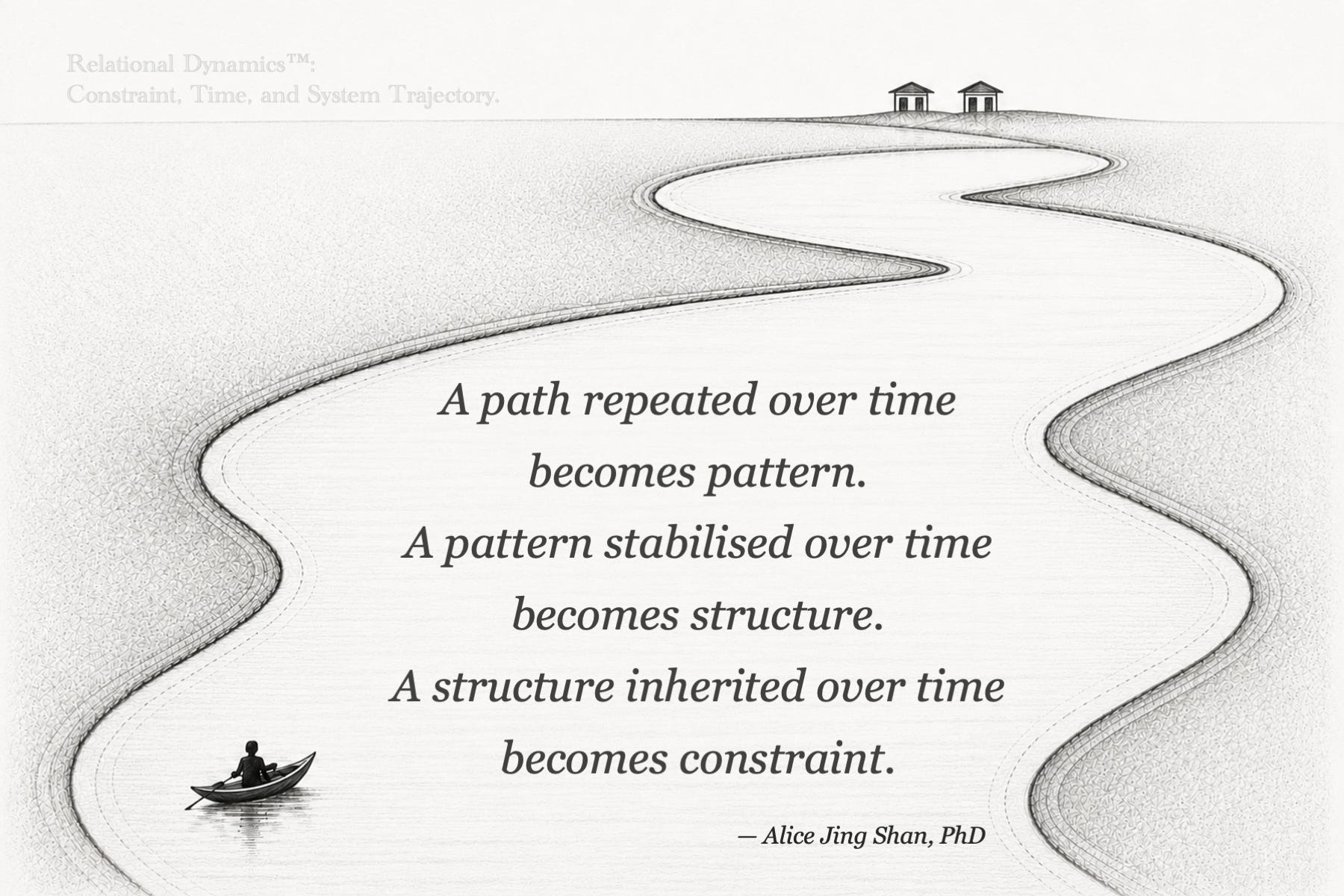
Figure 2. How movement becomes temporarily legible. Path, pattern, structure, and constraint are shown as temporal formations rather than fixed objects.
Governance After the Tool Frame
So, why does it matter deeply in the age of AI, or as I call it, the age of AIR?
AI systems do more than produce answers. They participate in the formation of habits, expectations, categories, shortcuts, dependencies, styles, and judgments.
They do not only respond to questions.
They also reshape the conditions under which questions are asked.
That is why governance cannot only ask whether an AI system is accurate, safe, biased, compliant, or explainable.
Those questions are necessary, but insufficient.
We also have to ask what kind of human-AI relation is being normalised.
Is judgment being strengthened, displaced, simulated, bypassed, or slowly weakened?
Is the interface making responsibility more legible, or simply making action smoother?
Who receives augmentation?
Who carries the risk?
Who becomes invisible inside the system?
These are not just technical questions. They are educational, organisational, political, ethical, and ontological questions. They are questions of relational dynamics.
A Small Analogy at the Edge of Resolution
A timely prompt came from Professor Seeram Ramakrishna, who shared with me a Nature Physics paper titled “A yardstick for quantum gravity”. I do not want to overextend the comparison, but the title brought a useful connection into view.
A similar issue appears when any system reaches the edge of its own resolution.
There is a loose analogy here with Planck units in physics, though I only want to gesture toward it lightly.
At ordinary scales, the background can remain background. At extreme scales, the conditions of measurement themselves become part of what must be understood. The issue is not simply that the unit becomes very small. It is that the old system of resolution begins to reach its own limits.
AI is producing a similar shift in reasoning. The conditions under which thought happens are no longer safely invisible.
I do not mean that human systems can be reduced to physics. They cannot. Human systems carry meaning, language, judgment, memory, power, and responsibility.
But when a pattern holds across very different domains, it may be pointing to a deeper structural problem: how relations, constraints, scales, and conditions make certain aspects of reality legible in the first place.
So yes, relational thinking is becoming visible now.
But I do not see this as a trend.
I see it as a response to a structural pressure.
AI is forcing us to notice what was always there: intelligence has always depended on relation, action has always depended on conditions, and meaning has always depended on the field in which it becomes legible.
Reality is relational dynamics under constraint over time.
AI did not create that reality. It made it harder to ignore.
Related Reading
Relational Dynamics™ · Ontology of Relational Dynamics · v0.2
The philosophical positioning paper for the Ontology of Relational Dynamics.
From AI to AIR: Augmented Intelligence Reasoning · v0.2
The positioning paper for AIR as the shift from AI as tool to AI as condition.
Relation Precedes Dynamics
A chapter from Dao: The Art of the Long Game on why relation has ontological precedence within relational dynamics.
Coupling Does Not Abolish Sequence
A chapter from Dao: The Art of the Long Game on why coupled elements still require attention to sequence.
Dao Models of Mutual Generation
A chapter from Dao: The Art of the Long Game on mutual generation, sequence, and relational formation.
The Less-Known Partner of Dao: Li (理)
A chapter from Dao: The Art of the Long Game, published on the Cynefin blog, on Li as inner grain, pattern, and intelligibility.
What is Formed is Still in Formation
The closing chapter of Dao: The Art of the Long Game, on why recognisable forms remain held, altered, strained, and carried through relation, dynamics, constraint, and time.
Small Analogy Referenced
A yardstick for quantum gravity
A Nature Physics piece on Planck units as a system in which quantum mechanics, relativity, gravity, and thermodynamics meet on equal footing. Referenced here only as a light analogy for what happens when a system reaches the edge of its own resolution.
The idea that "relation precedes dynamics" stayed with me after reading this essay.
Over the last few years, I have spent a great deal of time thinking about long-term human–AI interaction, especially questions of continuity, memory, drift, and trajectories over time. Reading this piece made me wonder whether I have sometimes been paying more attention to the trajectories themselves than to the relational conditions that make those trajectories possible.
That question felt particularly relevant to something I have been wondering about recently: whether language does more than communicate ideas. I find myself increasingly curious about whether language also helps shape the space of possible trajectories available to thought and interaction.
In any case, thank you for a genuinely thought-provoking essay. It gave me a new question to think about.
It reminds me of the little spider that rebuilds its web every day. It knows freedom only while hanging from its thread and gliding across its invisible surface. And the little fly, which flies freely through space, will suddenly see its reality freeze into that of the spider, until it is finally devoured.