

If coupling does not abolish sequence, then the next question is unavoidable: what, exactly, is prior within relational dynamics?
My own route into complexity discourse did not begin with complexity science. It began with life, with relation, with language, and with the lived dynamics of how human systems form and drift under pressure. Complexity came later, as one modern language for something I had already been seeing for a long time.
My starting point was relational. It was shaped by Chinese intellectual traditions and by lived experience. Discovering systems thinking later felt less like conversion than recognition. It was not the birth of the pattern, but the arrival of a vocabulary.
I kept noticing similar dynamics across very different domains. Not because the domains are identical, but because certain relational and generative patterns recur beneath different surface forms.
That is one reason I keep returning to sequence.
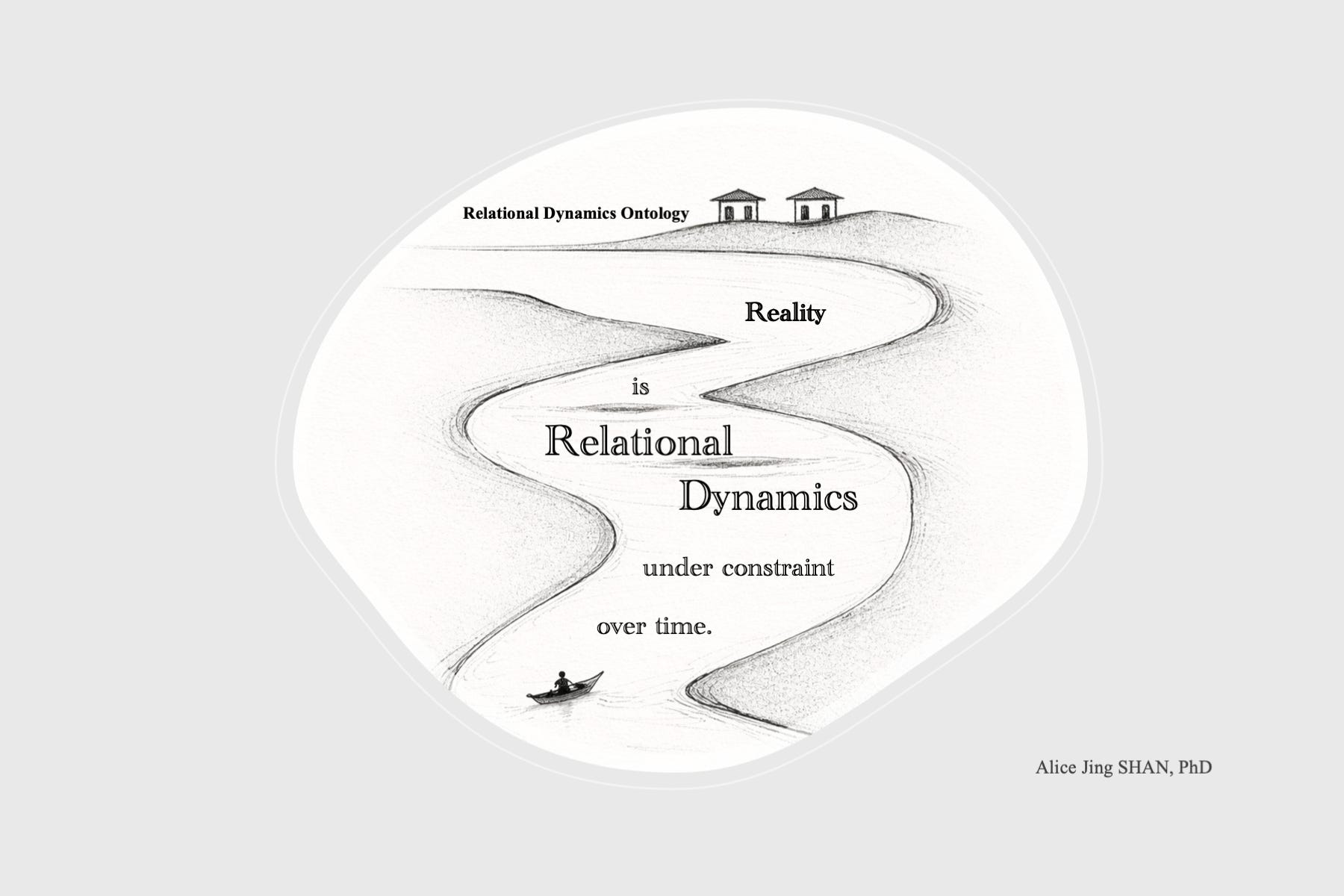
In my own work, this takes the form of a Relational Dynamics ontology.
Its core claim is simple:
Reality is relational dynamics under constraint over time.
But even within that coupling, sequence remains.
Relation is prior to dynamics, not in a crude linear or temporal sense, but as ontological precedence.
This does not mean relation is static. It is not. Relation is already dynamic, which is why I speak of Relational Dynamics rather than relation alone.
Even so, the distinction remains: dynamics become consequential only within relation-bearing fields.
What is formed is still in formation.
A form does not become fixed simply because it has become recognisable. It remains held, altered, strained, and carried through relation, constraint, and time.
In this sense, pattern is not the end of movement. It is one way movement becomes temporarily readable.
Dynamics do not happen in a void. Without relation, there may be motion, but not dynamics in the fuller sense I mean here.
Relation is not one variable among others inside a dynamic process. It is the condition under which movement becomes transmissible, intelligible, and consequential.
We notice dynamics first because dynamics are what move. They are visible, measurable, dramatic. But relation is what allows movement to matter across time, scale, and position.
Relation is what makes movement consequential.
This becomes clearer in ordinary life.
A conversation is not consequential merely because words are exchanged. What gives it force is that something relational already exists or begins to form: attention, trust, fear, recognition, dependency, familiarity, tension, expectation. The same sentence lands differently in different relations because relation is not decorative context around the dynamic. It is part of what makes the dynamic what it is.
The same holds in organisations and education.
A policy, instruction, or intervention never enters empty space. It enters an already existing field of relation: trust or mistrust, prior expectations, memory, recognition, coordination, avoidance. A child does not learn only because content is presented. Learning depends on the relation between learner and teacher, learner and task, learner and language, learner and environment. The information may be the same. The relational conditions of uptake are not.
This is why relation cannot be reduced to interaction alone.
Interaction names the movement. Relation names the condition within which movement becomes consequential.
At this point, the claim can be stated plainly.
Relation precedes dynamics.
Not because relation is static. Not because movement comes later in clock time. And not because feedback, reciprocity, or mutual transformation are being denied.
The point is simpler and harder than that: dynamics become consequential only within relation-bearing fields.
This is why I describe my work as Relational Dynamics, not as relation plus dynamics. The phrase is not additive. It names a coupling, but the terms inside that coupling are not generatively symmetric.
Mutual implication is real. Equal precedence does not follow.
Dao and Li were one way of seeing this. Relation and dynamics are another.
I will unfold this more fully over time. The present historical moment has opened a window through which many long-standing assumptions about human structure, meaning, judgment, language, and relation can be seen more clearly. Artificial intelligence is part of what has made that window unavoidable. It pushes the questions, including their philosophical underpinnings, further upstream.
So what matters here is not only a single argument, but a wider re-examination of what is taken as primary.
For now, I am placing a coordinate rather than exhausting the argument. This is not a rejection of what came before, but a way of re-reading earlier voices under the conditions of the present age.
Relation precedes dynamics.
Not because dynamics are lesser, but because movement does not precede the relational conditions through which it can travel.
Once that order is seen, much else begins to clarify.
Dao: The Art of the Long Game is an ongoing series exploring path, pattern, position, and future possibility.
I love what you are proposing here Alice as it truly makes me soften old notions and opens me to new reflections.
As I read, Maturana's Structural coupling comes to mind. His is a biological perspective but he also spoke of consciousness as possible because of our biology. Do you see a difference between what you are writing here and Maturana's investigations?
Thanks for the thought provoking articles!