

Time is often ignored precisely because it is always there.
After thinking about premature rescue, thresholds, and the danger of rushing what has not yet become viable in the previous chapter, the next question becomes unavoidable: why is time so often treated as background?
Perhaps because it is too constant to force recognition. People pay attention to resources, tools, money, labour, incentives, information, and skill, but not to time as an active element in system life. And yet if there is one condition no system can escape, it is time.
Time is not background. It is constitutive of system trajectory.
Time Is Constitutive
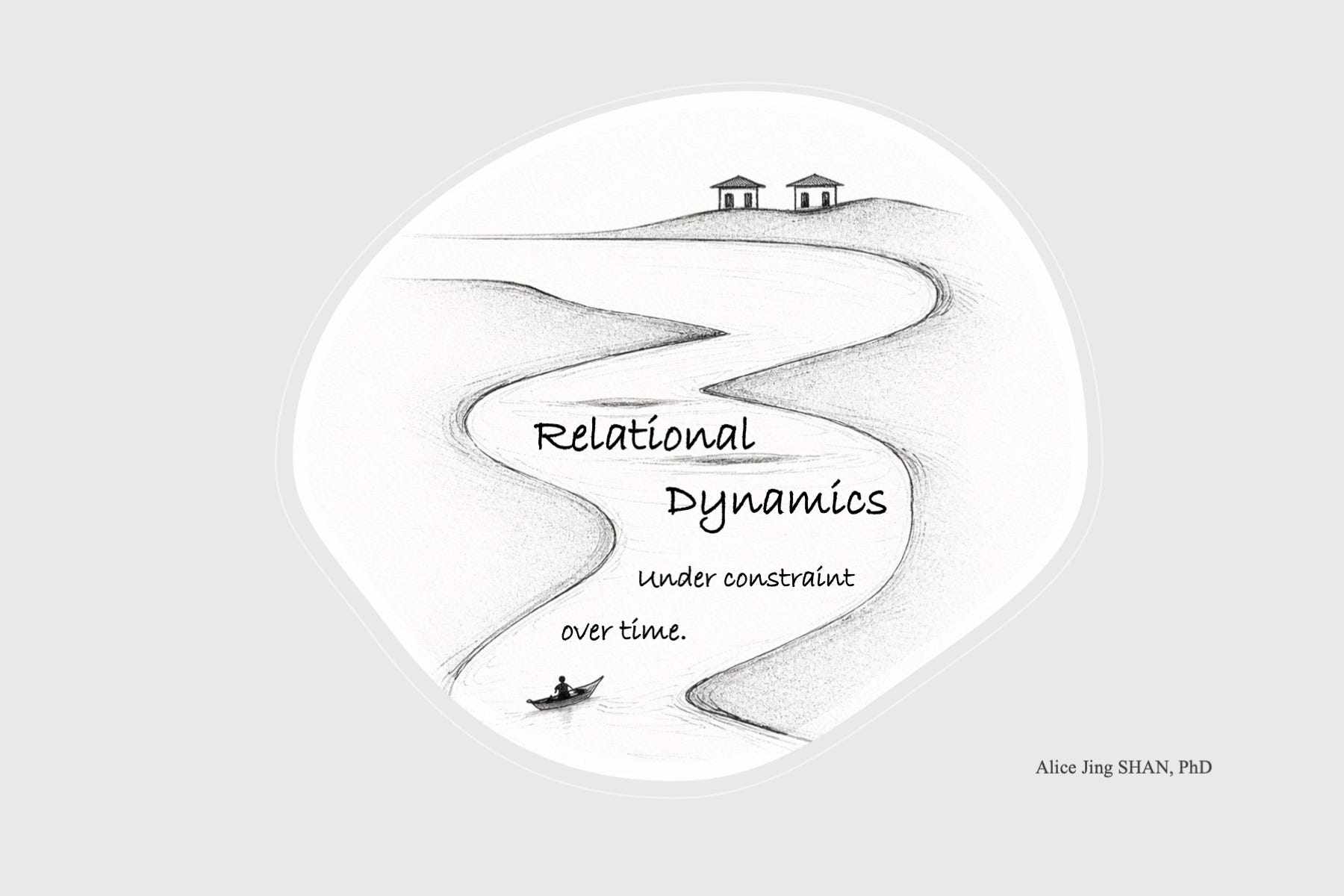
From the perspective of Relational Dynamics, my working frame is this: excellence is capacity held in coherence under constraint over time.
Capacity and coherence are variables; time and constraint are dimensions.
What this means in practice is simple but often overlooked. No system can be understood without asking not only what it carries, but how long it can carry it, and under what conditions.
This is why I do not treat time as a neutral container within which systems merely sit. Systems are not only in time. They are formed through time. Patterns stabilise through time. Capacities mature through time. Interfaces form through time. Thresholds are crossed through time. Relations become transmissible through time.
Chinese has a vivid idiom for this: 拔苗助长 (bá miáo zhù zhǎng), literally, pulling up seedlings to help them grow. The farmer is not cruel. He is anxious. He wants better growth, faster. But he misreads something fundamental: growth has an internal rhythm. External force may assist it. It cannot replace it. In that sense, time is not an obstacle to structure. Time is part of structure.
Time as Stress Test
Because time cannot be removed, it becomes the unavoidable stress test.
What appears coherent for a week may collapse over a year. What appears strong in low constraint may fail under sustained pressure. What appears workable in the short term may reveal itself, over time, as structurally costly.
Time does not merely reveal systems. It tests them.
Many of our discussions, however, are conducted in slices. We look at performance at a moment, coherence in a phase, failure at a point of visible breakdown, and mistake that partial view for the whole. But systems are not exhausted by snapshots. A slice may be accurate and still be radically incomplete. Time is what forces the distinction.
That is why so many misunderstandings in human life come from mistaking temporary performance for durable viability. A person, an institution, a relationship, or a framework may appear stable simply because not enough time has passed, or because the relevant constraints have not yet fully arrived. What looks solid may only be untested.
Many important structures are not absent. They are early.
Many failures are not failures of content. They are failures of timing.
Many misunderstandings are not really about disagreement. They are about premature contact without a viable interface.
And many forms of collapse happen because people attempt to extract legibility or performance before the conditions for them have matured.
The same is true in public life. A narrative may be available long before a population is ready to receive it. A warning may circulate for years before institutions can metabolise it. A framework may exist in full view and still remain unread because the field has not yet reached the threshold at which it becomes legible.
Timestamps and Early Structures
This is why timestamps matter, especially in relation to intellectual property. They are not only records of authorship. They are evidence that a structure was already there, even when the field had not yet developed the capacity, interface, or threshold to see it.
When people assume that invisibility means unreality, they often become careless toward formation. They dismiss what is still emerging. They ridicule what is still gathering. They overvalue what is already recognised and undervalue what is only beginning to take shape.
But reality does not wait for recognition.
A structure may be real before it becomes fashionable. A distinction may be real before it becomes teachable. A problem may be real before it becomes measurable. A developmental shift may be real before it becomes institutionally legible.
What is not yet visible may still be forming.
This is why some of the strongest actions are not acts of immediate persuasion, but of precise placement: saying something clearly, leaving a timestamp, building an interface where one can be built, refusing premature rescue, and keeping one’s own line steady while thresholds form elsewhere.
That is not passivity. It is long-horizon discipline.
In that sense, this chapter naturally returns quietly to Dao. A path does not become a path all at once. It is formed through repeated passage, held through time, and tested by whether it can continue to carry movement without collapsing into noise. The Way is not only direction. It is endurance under conditions.
Nothing important appears from nowhere. Conditions were gathering all along.
The same is true whether one is speaking of knowledge, structure, development, writing, institutions, or whole worlds.
Time is not background. It is part of formation, testing, legibility, and truth.
Time is never merely what passes. It is the medium through which system truth is tested.
Dao: The Art of the Long Game is an ongoing series exploring path, pattern, position, and future possibility.