

You Are Surrounded ⚫·⚪️
Before collapse, there is often an “oh no” moment. Not the final capture or total destruction, but the moment the board says: you are surrounded. There is nowhere left to go.
One of the deepest things Go teaches is that collapse rarely begins where collapse becomes visible.
By the time a position finally gives way, much of the structural work has already been done. The board may still look playable. Stones may still be standing. Moves may still be possible. But the path has already narrowed.
Sometimes, when players can see a few moves ahead, you notice a familiar gesture: a slight head shake, a pause, an “oh no.” Not because collapse has happened yet, but because the trajectory is already becoming legible. That is part of what makes the game so instructive.
What makes it psychologically destructive is something else.
Because you know there was a way. You know you helped lay the path yourself.
Sometimes it can feel as if you calculated so carefully to build an empire, only to realise that you were also, one step at a time, building the conditions of your own defeat. The pain is not physical. It is structural and psychological. You are not simply losing. You are watching the logic of your own earlier moves return on you.
That is why Go matters beyond the board.
Life Is Often Crueler
On the board, you may still have a chance to save the position. A stronger player may recognise, a few moves early, that the shape will no longer hold. In life, we rarely get that mercy.
We do not see the whole board, so people keep trying. They keep optimising, repairing, sacrificing, and hoping the next move will recover what has already been structurally lost. That is part of what makes collapse so difficult to read in real time.
The people inside it are often not blind. They often sense that something is wrong. They are often still acting in good faith, without being able to see how far the position has already shifted.
When the whole board is not visible, people can continue to act rationally within the portion they can see, even while the wider position has already narrowed.
This is not simply a personal problem of misjudgment. It is often a system problem of legibility. I have elsewhere called this Elegant Wall-hitting: the repeated collision between good-faith effort and an invisible structural limit.
Collapse Is Usually Delayed
We often imagine collapse as a dramatic event: one final blow, one crisis, one decision, one bad move. From a relational dynamics perspective, that is rarely how things work.
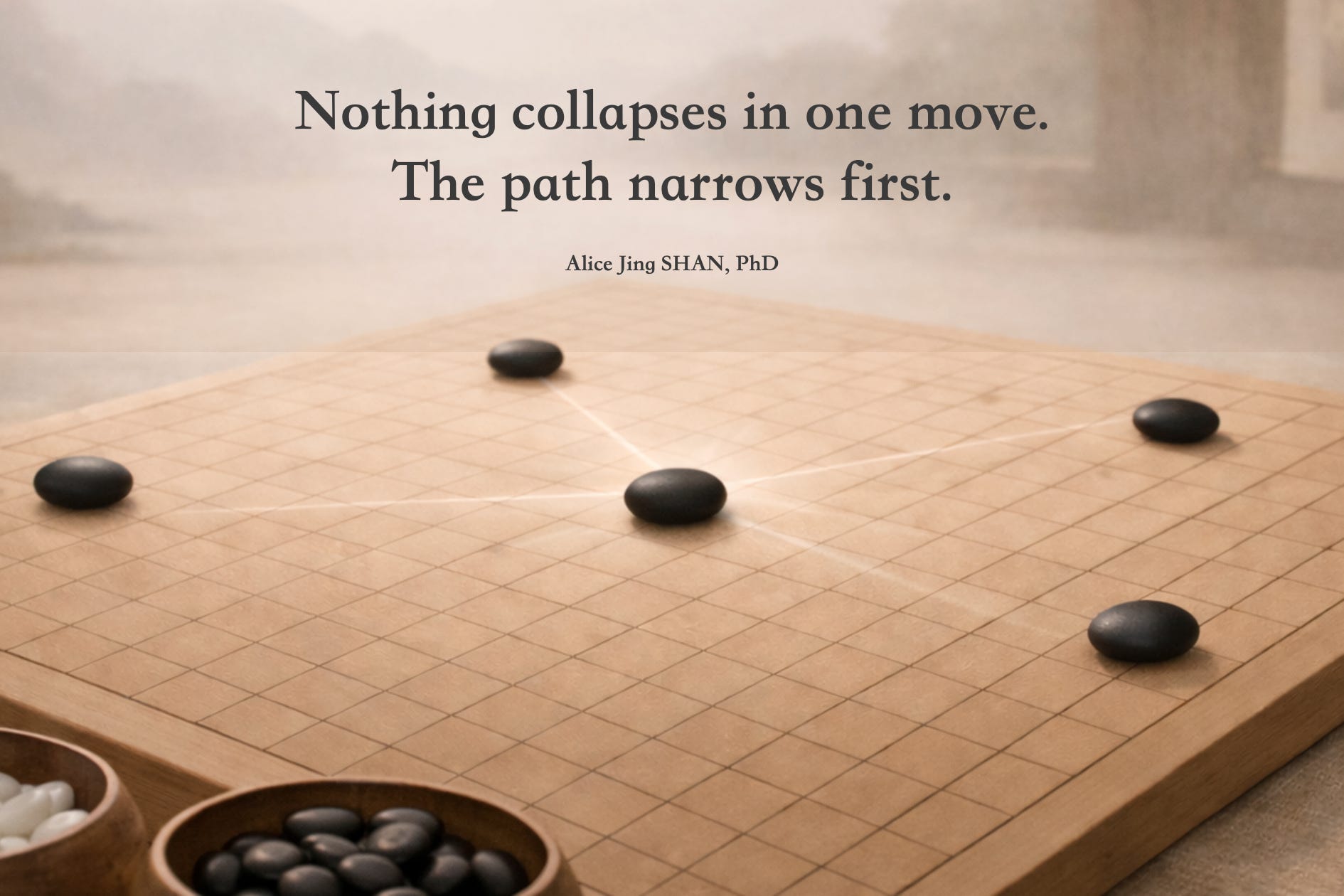
Nothing collapses in one move.
The path narrows first.
By the time failure becomes visible, much of the trajectory has already been laid down. That is true in Go. It is also true across systems:
an individual does not suddenly burn out in one day;
an organisation does not become fragile in one meeting;
an institution does not lose public trust in one moment of public drama;
a bridge does not collapse because of a few extra cars and visible cracks;
a camel does not break because of one final straw.
Surface function and underlying viability do not always decline together. A system may still look coherent, still compensate, still perform, while deeper conditions are already changing underneath it.
This is why I find collapse and risk so closely related. Collapse is rarely the beginning of danger. More often, it is the late visibility of a much longer process. What we later describe as risk or failure may already have been forming through earlier shifts in relational coherence under constraint over time.
When Corrective Capacity Starts to Thin
My interest in failure mechanisms did not begin recently. It goes back at least to my doctoral years. Even then, I found myself asking how highly capable people, under very different conditions, could end up making the same visible move: silence.
When I was growing up, I often heard a saying: “Silence is gold.”
Years later, in the context I was studying and working, silence was often treated as failure. Speech counted as success, contribution, participation. Silence was read as absence or non-engagement. What interested me was not silence itself, but the fact that the same visible outcome could arise from very different underlying conditions.
What appeared as silence was rarely a lack of ability. It was often the meeting point of cognition, motivation, language, power, and context.
That question has stayed with me ever since. The visible snapshot can be misleading. The deeper issue is often in the unfolding process.
That is why I keep returning to corrective capacity.
A system rarely fails at the moment it breaks.
It often begins failing earlier, when its capacity to correct begins to thin.
That thinning may first appear as fewer viable options, slower recovery, or solutions that seem to work while quietly reducing what can be restored later.
Load and constraint are never distributed neutrally. What presents as adaptation often depends on where the strain is being absorbed. This is how vulnerability accumulates: not through one decisive event, but through many small adjustments that preserve function in the present while weakening recoverability over time.
Collapse Is a Trajectory
In Go, this is easier to see. A position can still appear active even when it is already overextended. Stones remain on the board. Moves are still being played. But the ability to hold has quietly diminished. The future has narrowed before the collapse has arrived.
That is why the deeper question is rarely only, Which move was wrong?
The deeper question is how the path was formed.
What became connected and what did not, what was strengthened and what was merely patched, what was gained locally at the cost of wider coherence, what looked stable but was already relying on compensation elsewhere.
Collapse is not only an outcome.
It is also a trajectory.
The task, then, is not simply to identify failure once it appears. It is to learn how to read the conditions under which failure becomes more likely long before the final break.
That is one reason I find long-game systems so interesting. They force us to ask not only whether something still works, but whether it can still hold over time. Something may continue through effort, patching, overextension, and sacrifice. It may preserve surface coherence at the cost of deeper recoverability.
But endurance is not always viability. Sometimes what looks like resilience is only delayed collapse.
Go teaches this quietly. The move that finally loses the game is often not the move that truly lost it. It only makes visible what the earlier path had already set in motion.
The better question, then, is: When did the position stop being able to hold?
The path comes first.
The collapse only makes it legible.
Dao: The Art of the Long Game is an ongoing series on path, pattern, position, and future possibility.
Within it, wéi qí / Go forms one major companion line through which those questions become visible.
This made me think about winning/losing. I asked Claude about Go culture around losing and it replied: Go culture is striking precisely because it partially deconstructs the winner/loser frame. A few things stand out:
The post-game review (kifu analysis) is done together, by both players, immediately after. The loser isn't dismissed — they're a necessary collaborator in understanding what the game revealed. The game is treated as a shared object of inquiry, not a verdict.
And there's the ranking system — kyu and dan grades measure your development, not your opponents' defeats. You're being calibrated against a standard of play, not a pile of bodies. A strong player who plays poorly and wins is still judged to have played poorly.
The deeper principle is that in Go culture the opponent is closer to necessary resistance than adversary. The game can't form you without someone playing back. The opponent isn't the loser — they're the condition of your development. Which means the frame isn't really competitive at its core, it's formative.
There's a line often attributed to Go masters: the board is a mirror. You see your thinking in the position, not your opponent's defeat.
The connection to your thread is direct: if the player is the primary bearer of the pattern, then the game — the instantiation, the terrain, the project — is what tests and deepens the pattern. Winning or losing is almost incidental to whether you played with genuine understanding. The project ships or doesn't; what matters is whether you came out of it more formed.